

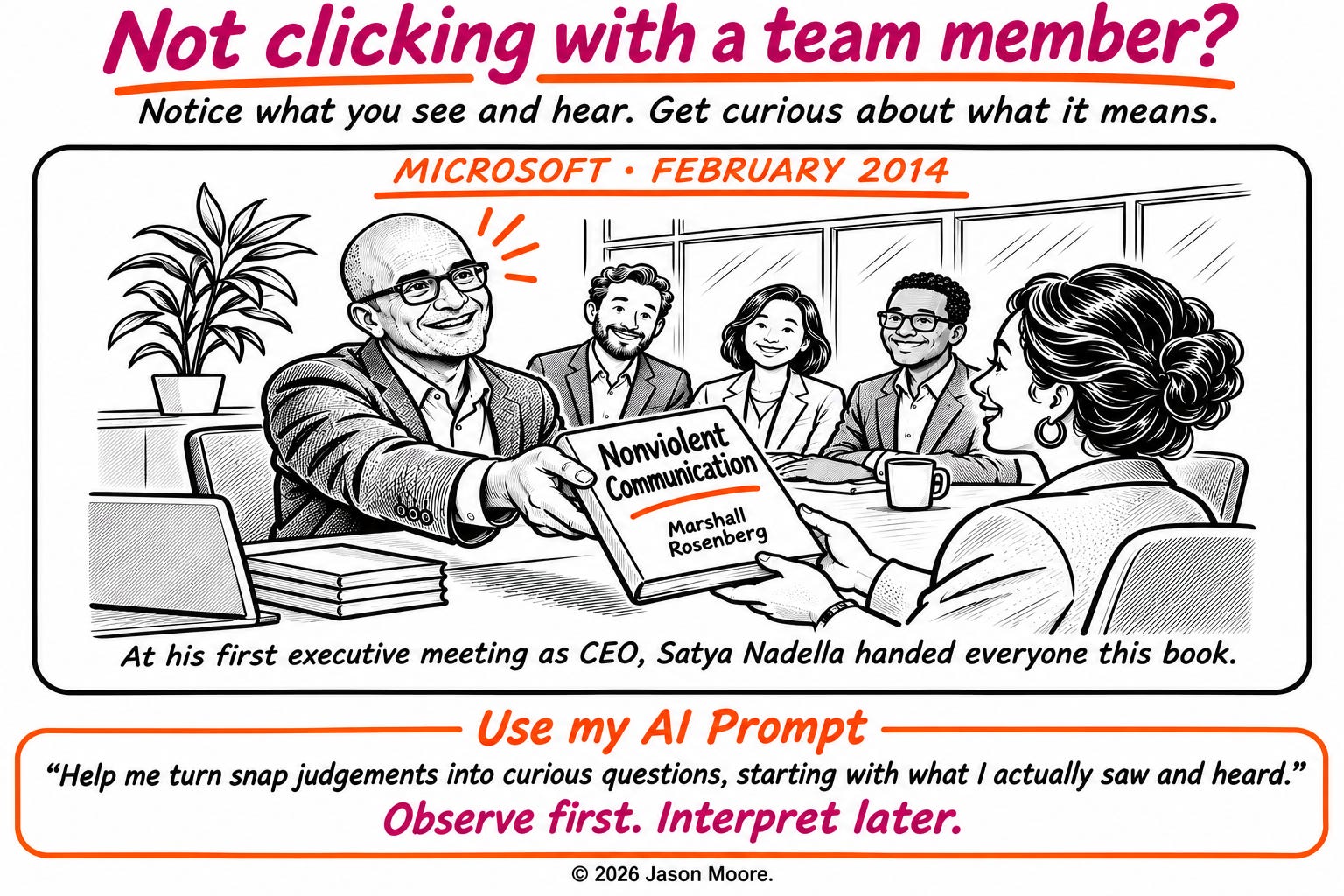
In February 2014, Satya Nadella became CEO of Microsoft. At his first executive meeting, he handed everyone in the room a copy of the same book: Nonviolent Communication by the psychologist Marshall Rosenberg.
The book starts somewhere deceptively simple: notice what a person actually says and does, before you decide what it means.
In my book, Who am I really?, I use the image of an iceberg to remind us that only a fraction of who we are is visible. The rest is hidden ‘below the surface’.
Others see our behaviour. Underneath sit our strengths, our passions, our values, our personality and the defining moments that shape our identity. Most of it is hidden from other people, but so much of it is coded in our behaviour, in our words, it’s a great place to start - especially if we are not clicking with someone.
When you’re not clicking
We all have one. The team member you just can’t find a way to connect with. They’re too slow, or too blunt. They go quiet in meetings, or push back on everything. You can’t quite put your finger on why it bugs you so much, but clearly something isn’t clicking.
Humans are prediction-making machines. We see that little bit above the surface and we immediately fill in the invisible nine-tenths with a story of our own.
They’re not committed.
They don’t respect me.
They’re difficult.
And once we’ve decided, our brains go looking for evidence that we were right.
What’s really going on?
Well, there’s usually a mis-match below the surface. You want speed, they want to get it right. You love lively debate, they need to think before they speak.
In the book, I suggest a simple practice for noticing what might be going on below the surface. Pick a person and ask yourself five questions:
What qualities or traits do you imagine this person admires most in themselves?
What would they speak about if given five minutes on a topic they’re passionate about?
What do you imagine they play, make and love to do?
What brands have you noticed them wear or use, and what might that say about their values?
What three emojis might they pick to represent their personality?
These questions won’t tell you who they really are, but they might give you better insight into why they act the way they do and say the things they say. That’s better than the snap judgement you made in the blink of an eye, unconsciously and based on your own preferences.
As I wrote in the book, I’d rather be thoughtfully wrong than thoughtless and unaware.
Now compare the answers you come up with for them with how you’d answer the questions about yourself. It might just tell you where the missing click is.
You can also share the answers to those questions as a team, but always share first, so they can see it’s safe.
And remember, this isn’t about prying. People get to choose how much of themselves they bring to work, and it isn’t always safe for them to bring more. Your job is to be curious and to make it easy for them to share, not to dig.
Here’s the prompt:
Copy this into your AI assistant of choice. Use initials or a nickname rather than your team member’s full name, and leave out anything confidential.
You are a practical coach. I'm not clicking with someone on my team. Help me understand them better before I decide what to do. Don't help me build a case against them.
Think of people as icebergs. I can see their behaviour, about 10%. Their strengths, passions, values, personality and defining moments sit below the waterline.
Ask one question at a time and keep your replies short.
1. Seen vs decided. Ask me for one or two recent examples of the friction. Sort what I say into Observations (what a camera could record) and Interpretations (my story about why). Point out any interpretation I've presented as fact.
2. Their iceberg. Ask me, one at a time: What do they seem to admire in themselves? What could they talk about for five minutes? What do they play, make or love to do? What brands do they wear or use, and what might that say about their values? Which three emojis might they pick for themselves? Treat my answers as guesses. If I don't know, tell me that's useful: it shows where I haven't been paying attention.
3. My iceberg. Ask me the same five questions about myself. Then put my answers side by side with my guesses about them and show me where we might be mismatched (for example, I want speed, they want to get it right). Neither of us is wrong.
4. Ask, don't guess. Remind me I can't see their values or the moments that shaped them; only they can tell me. Give me three open, low-pressure questions for our next one-to-one that would test my guesses, and one small thing I could do differently this week. If it fits, suggest how I could go first by sharing some of my own answers.
5. Wrap up. Finish with five lines: what I saw, what I assumed, where we might be colliding, the question I'll ask first, and the one thing I'll try.
Ground rules: No diagnosing, personality labels or speculation about their health or private life. If this sounds like a performance, conduct or wellbeing issue, tell me plainly to involve HR or a more experienced colleague.
Try it this week
Pick the person you’re clicking with least. Run the prompt. Then take one of the three questions into your next one-to-one, and listen to the answer like it might surprise you. It probably will.
Jason
You can find the book here