

In 2012, a team at Massachusetts General Hospital wanted people to make healthier choices in the hospital’s cafeteria.
First, they gave food and drink a traffic-light label: red for unhealthy, yellow for less healthy, green for healthy. Sales of the red items immediately went down.
Then they tried something even simpler. They made some of the green options, like bottled water, easier to grab (and unhealthy soda harder to reach).
In those three months, bottled water sales went up by 25.8% (at two other cafeterias on site, where the change had not been implemented, nothing changed).
Nobody was told to drink more water. The water was just easier to grab… so people grabbed it.
(Note: I drink more Coke Zero than I should. So I moved all the Coke bottles out to the shed at the end of the garden and put bottles of water in my officer. I halved my consumption of Coke and drink much more water now.)
When most of us decide to do something - like eat or drink more healthy options (or ask for more feedback and advice), we mean it. But a busy week arrives and the good intention disappears.
Then, we blame our willpower, which does not make us healthier (or whatever it is we want to change)
The real problem is, we are not setting ourselves up for success.
In my book, FAST Forward (a leadership fable about getting feedback and advice you love), Dr. Alix Chen says this:
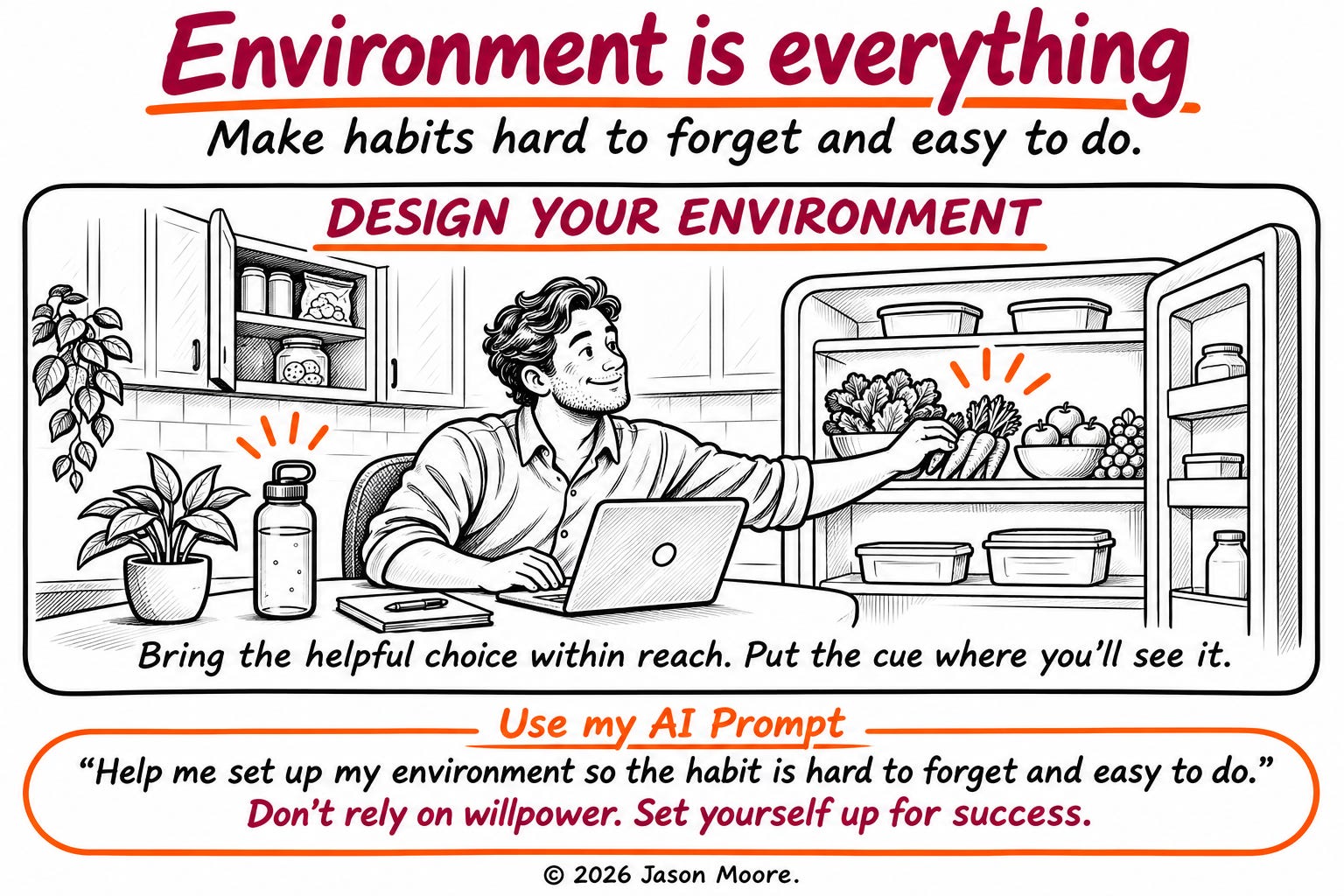
“If you want to eat more vegetables, put them at the front of the fridge so they fall out when you open the door.”
(Note: this is also how I lost 4o pounds)
She’s not just talking about our physical health. She’s talking about how we become high performance people. For example, often we don’t ask others for advice, even when we mean to, because life gets in the way and it becomes too hard.
This weeks AI prompt:
In this weeks prompt I’m sharing a simple way anyone can set themselves up for success. It does the equivalent of putting the bottled water easlily in reach, but in your specific circumstances (and around your habit-building focus area).
Here’s the key instruction: Help me set up my environment so the habit is hard to forget and easy to do.
And you can use it for any habit (not just asking for feedback or advice, but you should definitely use it for that).
How to use the prompt:
Copy the prompt below and paste it into ChatGPT, Claude, Copilot or whichever AI you use.
Don’t worry about the brackets. It’ll ask you for the details, one at a time.
Set up the one thing it tells you to set up today. It should take less than five minutes.
I'm building this habit: [HABIT, e.g. "ask one person for advice each week"].
The moment I want it to happen: [WHEN AND WHERE, e.g. "Monday team meeting" or "first thing when I open my laptop"].

If anything above is blank or still in brackets, ask me for it before you start. One question at a time, and wait for my answer.

Environment beats willpower. Help me set mine up so the habit is hard to forget and easy to do.

Give me two specific ideas for each:
- What I'll see, right before that moment. Desk, screen, wall, notebook.
- What my devices will do. Calendar, phone, reminders, AI assistant.
- Who'll notice if I skip it. A buddy, my team, my boss.

Be specific. "Put a sticky note saying 'Who will I ask this week?' on your monitor" beats "create cues."

Then pick the one I should set up today, in under five minutes, and tell me why that one.
Want more like this? The free FAST Forward email course gives you one simple framework a day for five days. Each email takes about five minutes. By day five, you’ll be asking for advice that actually helps, and getting feedback you’ll love.
Jason